
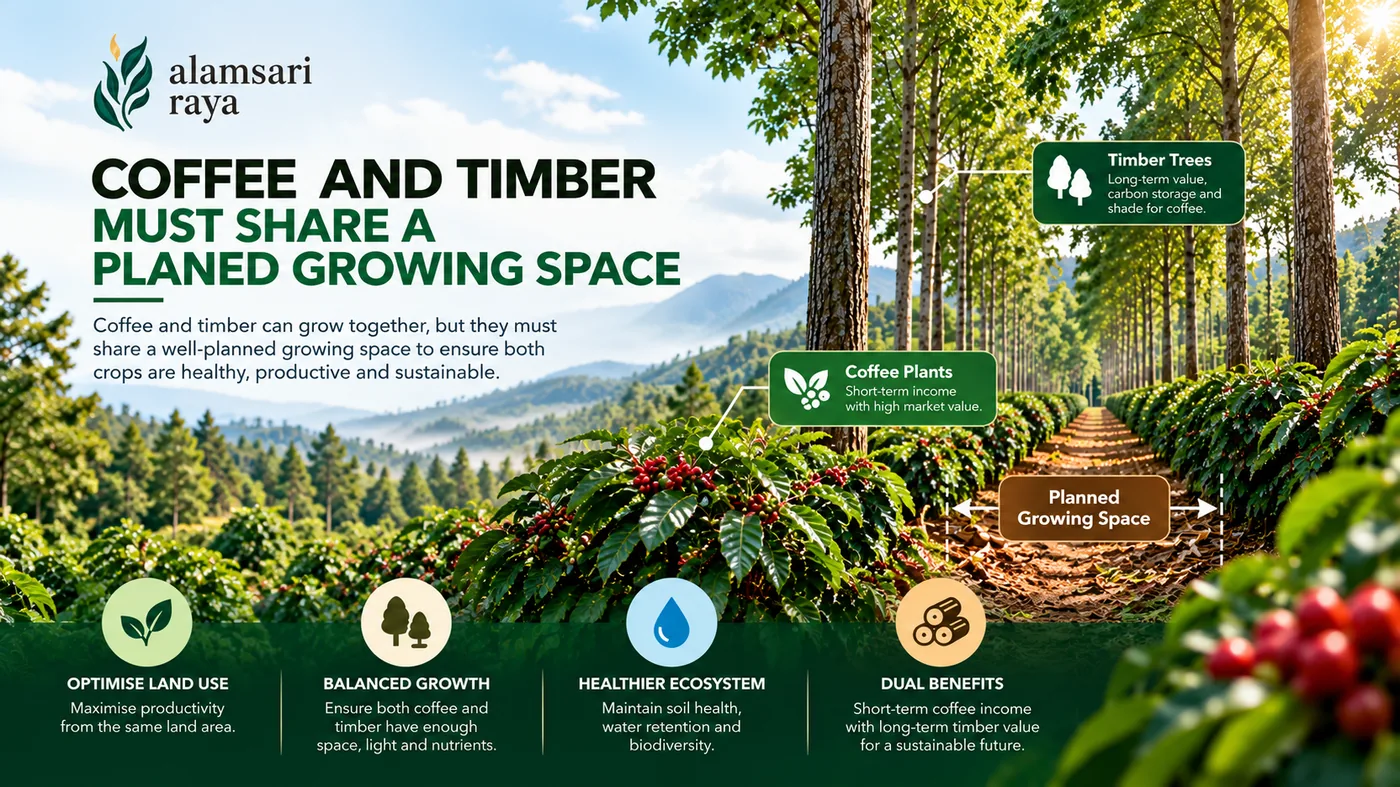
A timber tree in a coffee block changes more than the view. It changes the growing space and the work that can be done there. Coffee agroforestry should therefore be planned as a relationship between crops, trees and operations throughout their lives.
DaMatta (2004) reviews how shade interacts with coffee physiology, including the importance of water, nutrient competition and yield conditions. Food and Agriculture Organization of the United Nations [FAO]’s agroforestry guidance also highlights the possibility of crop damage during tree harvesting (FAO, n.d.-a). These issues make tree selection and rotation planning part of coffee management from the beginning.
We recommend assessing each proposed timber species against the intended coffee system. Document its crown shape, growth pattern, management needs and expected harvest approach. Consider which parts of the block will receive different light conditions as the trees grow. A suitable species still needs a suitable arrangement.
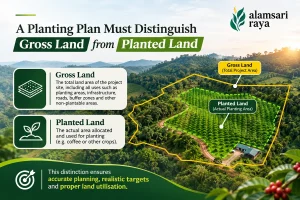
The farm map should show more than planting rows. Mark timber access routes, sensitive areas, turning spaces and the places where harvested wood may be handled. Discuss how pruning and eventual timber operations will protect coffee plants and keep workers safe. Leaving this discussion until timber harvest approaches can make a promising combination difficult to manage.
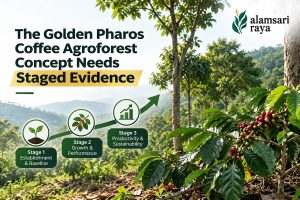
A useful demonstration compares coffee performance across measured positions relative to the timber trees.
Record distance, canopy condition, plant health and harvested output. Where a plant performs poorly, inspect several possible causes before deciding that shade alone explains the result.
Financial planning needs the same attention to timing. Coffee and timber generate products on different schedules.
We propose separate records for each product, then a combined operating view that shows shared costs. This helps prevent a future timber receipt from hiding a current coffee maintenance problem.
For Alamsari, sharing land between coffee and timber is a design challenge worth studying openly. The strongest model will be one in which the crop arrangement, operating access and financial logic remain workable as the system matures. Readers assessing a similar project can begin by asking for a map of the mature system, rather than only its planting day layout.