
More coffee plants per hectare can create an opportunity, but the planting count is only one part of the decision.
A high density system also needs a plan for plant growth, access, labour and the surrounding timber canopy. Its
commercial value depends on the performance of the whole block.
Alamsari’s Kampung Tepus briefing proposes Robusta planting at approximately 3,000–3,500 plants per hectare,
with a 3 m by 1 m spacing illustration (Alamsari Raya Sdn Bhd, 2026). The simple geometric calculation gives about
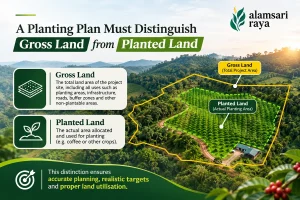
3,333 planting positions per fully planted hectare. The actual count must allow for paths, drains, buffers and other
excluded areas.
In Uganda, Sseremba et al. (2021) compared Robusta under 3 m by 1 m and 3 m by 3 m spacing. Closer spacing was
associated with higher estimated yield potential per hectare, alongside mixed pest and growth responses. Field
age and other differences also require caution. This provides a reason to investigate density locally, rather than a
Malaysian yield guarantee.
Start with the intended mature plant. Identify planting material, stem numbers and pruning. Check whether
workers can enter mature rows safely with equipment and harvested cherries. A layout must work after both coffee
and timber crowns expand.
Next, separate trial learning from commercial forecasting. Compare selected densities under documented shade
conditions. Record survival, pest observations, labour hours, harvested cherry and saleable green coffee. Use
repeated observations over time, so one unusually good season does not become the entire business case.
Finally, calculate the extra cost of a denser block. More planting positions can mean more nursery material and
establishment work. The question is whether any additional saleable output covers those costs and remains
manageable as plants mature. Lower yield per plant can still accompany higher output per hectare; both measures
need clear units.
Alamsari’s interest in high density planting is therefore an interest in efficient land use supported by disciplined
management. The appropriate density will emerge from crop performance, operating practicality and economics
together. That is the evidence we want to make visible as the model develops.