
A coffee agroforest collaboration should explain how its farming concept will be tested before the model is
expanded. For public agencies and financial institutions, the key is a clear connection between development steps,
evidence and the next decision.
Alamsari’s website records a Golden Pharos visit to AReA Centre for learning about agroforestry and regenerative
agriculture (Alamsari Raya Sdn Bhd, n.d.-b). The proposed Coffee Agroforest Project with Golden Pharos forms part
of Alamsari’s development agenda. This article explains a recommended learning framework; it does not announce
completed planting, regulatory clearance or commercial harvest.
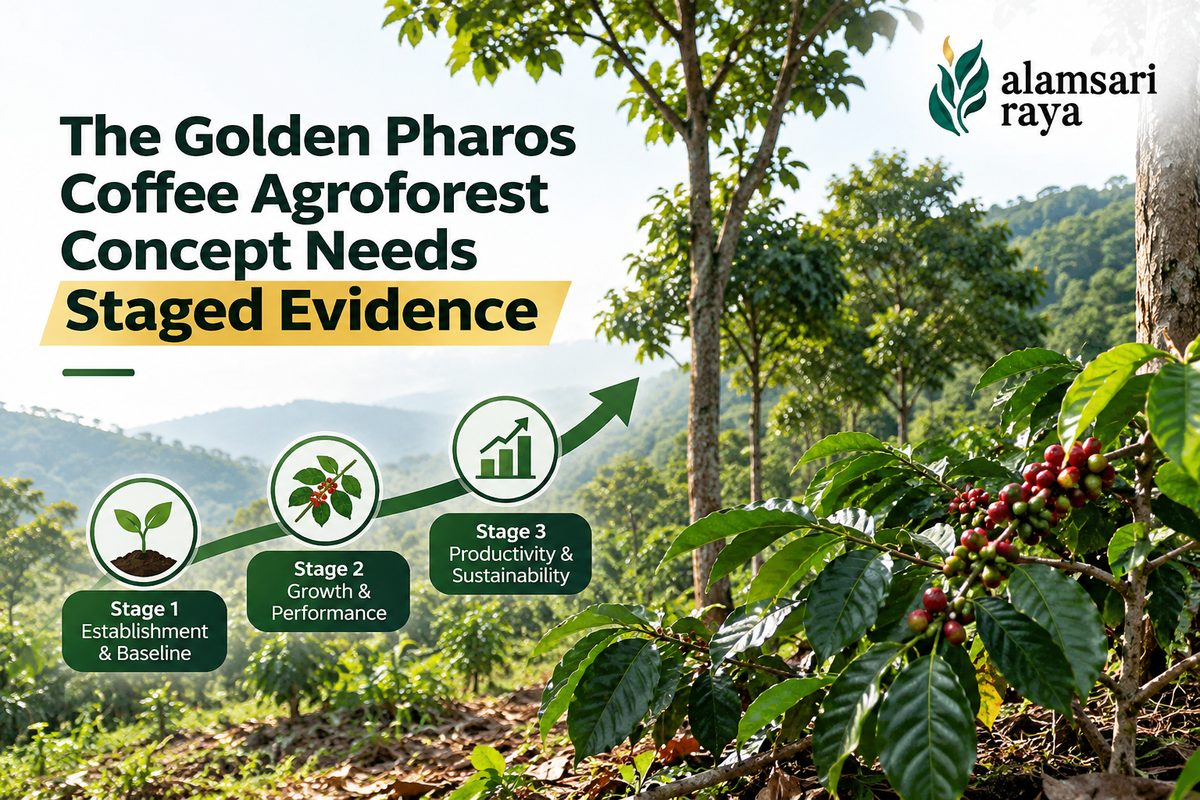
Food and Agriculture Organization of the United Nations [FAO] recommends small scale testing and cost benefit
assessment for a proposed agroforestry system (FAO, n.d.-a). We propose translating that principle into a staged
evidence record for the coffee and timber combination.
The first stage should document the site and operating basis. Identify the authorised area, relevant permissions,
land characteristics and the intended relationship between coffee management and timber operations. A project
description should distinguish a collaboration discussion, an approval and an implemented activity so readers can
understand what has actually happened.
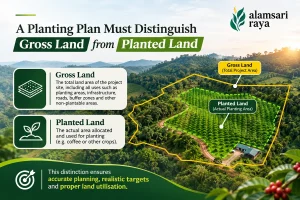
The next stage should investigate establishment and operating practicality. Record planting material, net planted
area, survival, canopy conditions and the labour required for maintenance. Use the observations to refine the
layout and management approach. A pilot should have a decision question, rather than merely a smaller planting
target.
When harvest becomes available, extend the record through processing to saleable green coffee and realised sales.
Output should be reported with clear units and dates. The performance of a developing block should not be
confused with a mature annual production assumption.
Finally, use the evidence to decide whether, where and how to expand. A change of plan can be a valuable outcome
if it prevents an unsuitable layout from being repeated. Alamsari’s proposed communication approach is to publish
approved milestone summaries that show the activity, the evidence obtained and the next step. That will make the
collaboration easier to understand without asking readers to treat an ambition as an achieved result